Sleep and Adoption
"People who say they sleep like a baby usually don't have one." - Leo J. Burke
The Problem ...
Dr. Sears: "Thou shalt cosleep, unless you don't really want that special bond we like to call attachment."
Dr. Ferber: "Thou shalt let them cry, unless you don't really want that thing we like to call a good night's sleep."
Dr. Dobson: "Good night's sleep? Have you considered a good night's spanking?"
Dr. Weissbluth: "If you don't sleep train them now, there's a 92% chance they'll be huffing paint behind the Quik-E-Mart by age 16."
That neighbor whose kid would have slept well even if raised by wolves: "Really? Our precious Tyler slept through the night since he was 2 months old ..."
Attachment therapist: "Never let their feet touch the ground ..."
Movement therapist: "But if she doesn't learn to crawl soon, her left brain will never talk to her right brain!"
Mother-in-law: "You're spoiling that child - she needs to cry it out."
APmom on your 4am chat group: "Cherish these magical middle-of-the-night bonding opportunities - not ever sleeping is a glorious gift!"
Dad: "Honey, the baby's crying ..."
Mom: "Honey, why don't you go cherish this particular magical moment ..."
Too many experts, not enough left brains talking to right brains. Too much opinion, not enough research. Too much crying, not enough sleeping. What's an adoptive parent to do? Read on, my sleepless friend, as we tiptoe through the too-often tendentious topic of SLEEP.
What is this thing you call sleep?
So much depends on adequate, restful sleep. We've got important work to do at night, from physical growth (80% of growth hormone is secreted while we sleep), to mental growth (integrating themes and memories of the day), to recharging cellular batteries, and other functions that we just haven't understood yet.
We all sleep in cycles, but children have unique sleep patterns. As infants, they have many sleep periods through a day, and a greater proportion of active (REM) sleep - about 50%, with the other half being "quiet sleep", a precursor to more developed Stages 1-4 of non-REM sleep. By 3-4 months, melatonin turns on, and infants organize their sleep into more of a day/night pattern. This is why it's silly to expect children to sleep through the night before 4 months.
By 6 months, the full cycle of non-REM and REM sleep is happening, but infants can get into Stages 3 and 4 (deep sleep) much faster than adults, and still spend more time in REM sleep. Deep non-REM sleep is important, since it's the most restorative phase of sleep, and is also when growth hormone is released. REM sleep seems to process and organize new memories and events, and is crucial to mental wellbeing.
By 3-4 years of age, children's sleep finally resembles adult sleep in quality, with 4-6 sleep cycles. The first half of the night has more non-REM sleep, with more REM sleep in the second half.
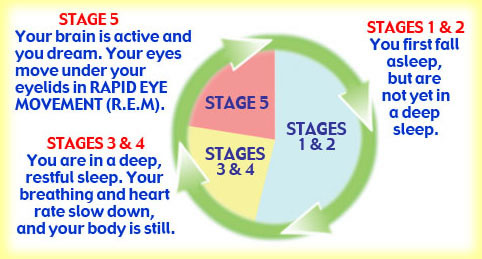
Image from SleepForKids.org, an excellent resource from the National Sleep Foundation
You'd think with something this important we'd be born good at it ... but we're not. Not even close. Just like walking and talking, the ability to fall asleep and stay asleep is something that is learned at developmentally appropriate times. How and when to help your child learn is the hard part.
Why bother? Sleep deprivation is being increasingly linked to emotional and behavioral problems, poor concentration, impulsivity, ADHD misdiagnoses, impaired learning, reduced physical performance, poor growth, headaches and bellyaches, and decreased immune function, not to mention family stress.
Sleeping through the night?
As for "sleeping through the night" ... nobody does. We all wake up to some degree several times a night, often when our sleep cycles from deep to lighter sleep. Arousals after REM sleep also occur, and tend to leave you more awake and alert. You may not be up long enough to remember it (that takes 3-5 minutes), but you do wake up, even without the "help" of your less sleep-skilled child. Our goal, thus, is not to "sleep through the night", but to promote healthy sleep associations and self-soothing skills so that your kids will fall back asleep when they wake 5 times every night.
How common are night wakings that you'll notice? By 4-6 months, babies are physiologically capable of sleeping through without feeding, but according to the 2004 Sleep in America poll, 70% of these infants still wake up and need help or attention, with 47% of toddlers, 36% of preschoolers, and 14% of school-age children also with notable wakenings. The numbers seem considerably higher in new adoptees, for reasons we'll address below. As far as other sleep difficulties go, the same poll revealed that 69% of all children experience one or more sleep problems, including stalling, bedtime resistance, and daytime sleepiness.
How much sleep does my child need?
The following table is based on sleep surveys and recommendations from the National Sleep Foundation:
Age |
Total Sleep Hours |
Hours at Night |
Number of Naps |
0-2 mo |
10.5-18 |
What night? |
It’s all naps … |
2-12 mo |
14-15 |
9-10 |
3→2
|
1-2yo
|
12-14 |
11-12 |
2→1
|
2-3yo |
12-14 |
11-12 |
1 |
3-5yo |
11-13 |
11-11.5 |
1→0 |
5-12yo |
10-11 |
10-11 |
You wish |
13-18yo |
8.5-9.5 |
8.5-9.5 |
They wish? |
While each child is unique, it's rare for kids to need much less sleep than these recommendations. However, there does seem to be individual variation in amount of needed sleep, as well as "night owl" vs "early bird" variation; these patterns are present from early childhood and are fairly stable. As for the naps, children who nap are happier, have better attention spans, may learn better, and arrive at bedtime without being overly tired. Good naps lead to good night-time sleep, and vice-versa. "Sleep begets sleep." Just try to keep naps from lasting into the later afternoon. For a great discussion of the how and why of naps for one and all, see Sleepless in America.
Special Concerns in New Adoptees
Sleep disturbances are far and away the biggest initial concern for the new adoptive families that come to our clinic. Most new international adoptees sleep well enough on the trip home - quite possibly because they're thoroughly overwhelmed and emotionally exhausted by this transition. When you arrive home, 1-2 days of jet lag per time zone crossed is typical, but children often recover before grownups.
Learning as much as possible about the prior sleep environment and bedtime routines can be very helpful. But since orphanages can have unnaturally long naps and early bedtimes (often aided by medication, sadly), you may not want to follow their timetable precisely. Remember that children from orphanages may never have been alone in a room, and will need a prolonged transition to sleeping by themselves. Children in foster care may have quite evolved bedtime routines, transitional objects, and sleep habits ... such as cosleeping, which is common in Korea and many other countries. Even the clothes they came in have reassuring smells and associations, so keep them around ...
If the "cry-it-out" methods work as advertised, then why do kids from orphanages who've unfortunately been crying-it-out their whole lives sleep so poorly at first? Well, since almost every aspect of bedtime and your child's new sleep environment is different and thus "wrong" at first, it's natural that new adoptees have difficulty falling asleep and falling back asleep during night arousals. Your child's grief at the loss of familiar caregivers may erupt at night, and when you come to console them they may be expecting someone else.
New adoptees are usually so overstimulated (we call it "Disneyland syndrome") that they may blow right through sleepytime into an adrenaline-addled second or third wind. Also, your child is experiencing dramatically more love and stimulation, is having rapid catchup development, and we know that children working on new skills often obsessively practice or at least cogitate upon these new milestones. Nightime is no exception, and it's not unusual to find children happily or unhappily attempting new feats in the crib.
Children experiencing parental love and attention for the first time are understandably reluctant to give it up because someone says it's "bedtime". The early stages of a new attachment have an insecure, "velcro" quality, so it's normal for new adoptees to be anxious and insecure around bedtime. If they won't even let you have a bathroom break, how are they suppose to handle the big kahuna of daily separations - bedtime in their own crib? Add to that the fact that it's developmentally normal for kids to have a flareup of separation anxiety at around 18 months, and you got quite an anxious child on your hands.
Plus ... it's scary in the dark, even for many "home-grown" kids. On top of that, think of all the negative associations with nighttime your adoptive child may have had. Being cold, soaked through the rags that served as diapers, in a hard metal crib, with no one answering your cries, and waking up to a different shift of caregivers is not a good memory. Neither is hearing your first parents yell and hurt each other late at night.
Finally, children with histories of prematurity, prenatal substance exposures, lack of early responsive, regulating caregiving, and stressful/traumatic experiences can literally be wired differently, with real neurologic differences in sensory processing and self-regulation. Children with oversensitivities to sound, light, or touch are more likely have difficulty filtering these inputs out at night. Children with poor emotional and self-regulation experience their emotions more intensely, and have difficulty self-soothing. The process of "attunement" (a powerful emotional connection in which the caregiver recognizes, connects with, and shares the child’s inner states) with a responsive caregiver is necessary to help your child identify, organize, and work through their emotions. That attunement, more than "crying-it-out", is what will rewire your child so that they develop genuine self-soothing skills. Try to see initial nightime wakenings with empathy for where they're coming from and what they're now experiencing.
For all of these reasons, most adoption professionals do not recommend sleep training that involves prolonged crying in the first few months home. You may have brought home an 18-month-old, but he/she may be emotionally younger in many ways, and your relationship itself is a bouncing brand new baby ... one that will keep you up more than you might like in the first few months. Plan on being more emotionally and physically available at night, and try to think of these nightime interactions as an opportunity for bonding, and a way to repeatedly show your new arrival that she is loved, safe, and well-cared for.
But keep your eyes on the prize - restful restorative sleep for all. It's never too early to set up good sleep habits, and help build self-soothing skills. You'll probably want to have both a transitional sleeping plan, and a longterm plan. Get the The No-Cry Sleep Solution for Toddlers and Preschoolers or Sleepless in America, and one of the "sleep training" books (Sleeping Through the Night is my favorite, but see our list of recommended Sleep Books), and get down to learning and soul-searching about what's going to work for your family in the short and long-term. Pantley's questionnaires can help guide the discussion, and the National Sleep Foundation's Children's Sleep Diary (pdf) can help analyze a school-age child's sleep patterns (or use this simpler sleep log for younger kids) ...
While the transitional plan should probably involve some parental presence during sleep onset and night arousals, the longterm plan is up to you. It's a emotionally loaded powder-keg of competing sleep philosophies out there, and I'm not going to light the fuse. If you are loving, attentive, and attuned during the day, and have been responsive to transitional sleep issues in the first months home, you do have my permission to move into some modified "gentle" sleep training if that's what you need to do (prolonged hysterical crying does feel traumatizing to many of us, though). You also have my blessing to cosleep 'til the cows come home, as long as you're all cosleeping and not cosleepless.
Bottom line - know thyself, and know thy children. If they have histories of trauma or neglect, you don't want to reinforce those stress-forged neuro-endocrine pathways by retraumatizing them. If a method feels like torture, or just isn't helping your child, then try something else. Sleep training is not a one-size-fits-all solution; some children may settle quickly after a brief fuss that blows off some of the stresses of the day. Some will cry for HOURS and devolve into a sweaty, snot-smeared, how-dare-you-do-this-to-me, too-frantic-to-sleep zombie. And they'll do this every time the routine gets off and you have to "re-sleep-train". Weigh the risks and benefits for your family. What's worse, lonely frantic crying and loss of loving, attuned care at night, or having a dangerously sleep-deprived, depressed, not-so-attuned parent during the day? There's no right answer to that ... you need to trust your instincts here. That said, I do think Mary Sheedy Kurcinka's Sleepless in America is the closest I've read to "the right answer", since she skillfully walks you down the path of what underlies your child's sleep issues, and helps you adjust your approach to your child's temperament. Very very highly recommended.
Let's get practical ...
After all this sleep theory, I know that you wanna get practical, so let's get into practical:
Zeitgebers
But first, more theory. Ha. Just kidding. Zeitgebers are the "time-givers", the environmental cues that set or reset our biological clocks. Because we run on a 25-hour clock, and the world runs on a 24-hour clock, we need daily cues to continually set our circadian rhythms. And trust me, you need these right now, especially if you just got off the plane.
- Light is the major zeitgeber - keep things dim in the hour before bedtime, dark at night except for a dim nightlight if necessary, and brightly lit through the day. A sunny breakfast first thing in the morning is ideal.
- Physical handling and eye contact are potent stimuli that can boost adrenaline levels. Keep the physical play and long intense gazes for daytime ... but soothing contact like rocking and gentle backrubs work well at night.
- Food routines can help maintain circadian rhythms, so try for consistency in your meal/snack/bottle schedule.
- Vigorous physical activity during the afternoon can make a big difference at night as well. Go for a big hike or playground session - your new arrival may have more energy than you think.
Bedtime Routines
Even if you're a free spontaneous spirit, your child is gonna need a bedtime routine. Young children thrive on predicability and routine, and that goes double for post-institutionalized children. How long should it be? How about 30-40 minutes ... sound too long? Well, how long does your child take to actually fall asleep after you "put them to bed"? Either you've just found some time that could be better spent on a cozy, bonding bedtime ritual, or you've won the sleep jackpot (don't tell the other parents). When things are going well is when it makes sense to trim it back to 20 minutes or so. Here are some ideas for your bedtime routine ...
- The whole hour before bedtime should be free of TV, computer games, vigorous play, or other stimulating activities.
- Sleepy-time snacks. Preempt the "I'm still huuuungry" calls with a healthy and even sleep-inducing bedtime snack. Complex carbohydrates, as well as turkey, peanut butter, bananas, soy and dairy products (which all contain tryptophan) can help you get your sleep on. Best eaten half an hour before bed.
- Review a pictorial sleep routine story that you wrote/drew together to reinforce the prebed ritual, and to confidently anticipate sleep successes. These sorts of personalized picture stories can really help in any anxious situation.
- Baths. Who doesn't love a bath? Well, the kids who got stuck under a cold faucet during diaper changes don't love the bath so much at first, but usually quickly warm up to the concept. Try not to make it a wet 'n wild play session, though. Remember - "you're getting sleeeeepy ..."
- Brush the teeth. Battery-powered toothbrushes are fun. So are tasty toothpastes. "Should I brush your teeth ... or your bellybutton?" Riff on your routine with absurd suggestions - they like it, and it builds language in the younger child or new English speaker. My niece likes to "teach the cat how to brush".
- Change into PJs ... and don't forget to change out of PJs in the morning - helps them be a more powerful sleep association.
- Bedtime bottle? The dentists just can't seem to win on this one ... but certainly no caloric beverages in the crib/bed, and it's nice to finish feeding 15 minutes before sleep to let saliva wash out some of those sugars, and to avoid setting up drinking as a sleep association that won't be there in the night. Milk, formula, and breastmilk are all soporrrific!
- Take a tour of the room, saying goodnight to all the favorite toys. Doubles as a language lesson for the English learners.
- A bedtime prayer is part of many bedtime rituals ... think about the content though. "If I die before I wake" might not be your best sleepytime thought.
- Put your child in his bed or crib and take up your station next to him. Oh look, was there a nice little not-too-stimulating surprise waiting in bed? Maybe a sticker? Or a new book? Isn't going to bed dandy?
- Do consider a gentle, soothing back massage or foot rub. Massage can work magic at bedtime, unless your child is overly sensitive to touch or ticklish ...
- Bookreading. Let your child choose 2-3 books. The lights should be really dim by now, so it's not about the pictures, it's about your soothing voice. If your voice needs a rest, try a tape of you reading, or an audiobook.
- "Goodnight, you princes of Maine, you Kings of New England ..." What will you leave your child with each night?
Bedtime Itself
It's earlier than you think. In fact the ideal toddler bedtime is often somewhere between 6:30 to 8pm.
-
Use your sleep logs to keep track of when your child shows signs of sleepyness, and when he actually falls asleep.
- If you miss it, poof goes the easy sleepy bedtime - tired cranky adrenaline-addled children don't fall asleep well.
- If you get home from work late, you may need to rejigger that or make early mornings your quality time.
- If you're having sleep issues, you're well advised to keep sleep schedules the same 7 days a week. Which means keeping the bedtimes the same, but also not letting them sleep in much past their usual/appropriate wakeup time (ouch).
- That said, sometimes your child's current circadian rhythms has him going to bed later than you think. Try letting the bedtime start out later but inch it backwards by 10-15 minutes per night.
Falling Asleep
This here is the key, folks ... the associations your child has with that golden moment of falling asleep will be the ones she needs each time she wakes in the middle of the night. Do everything in your power to let that moment be on her own. No feeding, no rocking at that moment, if you can. Stay in the room at first, by all means, stay next to the bed or even in it if you must ... you can wean that later if you want. Falling asleep is hard to do if you are anxious and having difficulty letting go ... Here are some ideas to help with the weaning process, which may take weeks to months.
- Does your child have a "lovey", or transitional object, that can represent the emotional security she's building with you? If she didn't arrive with one, have an array of dolls, stuffed animals, and blankies around for a few days and see if she gravitates to one. Several of my patients swear by the Slumber Bear that plays womb sounds when jostled.
- When she settles on one, experienced parents keep backup loveys on hand, and even rotate them so they're equally worn and stinky.
- Maybe there are a few nonsense "errands" you need to do, in the room or out of it? But you'll be right back.
- In fact, you can set a silent timer like an hourglass egg timer or visual timer and tell her that you'll be back in 3 minutes when the timer is done. Come back, check on her briefly, and repeat. Make sure you do come back.
- Even if you're not doing the timer thing, coming back in for brief checkins when your child is not screaming for you is reassuring and rewards good bedtime behavior.
- Successes with independent falling asleep are often followed by fewer night wakings in 1-2 weeks.
Night Wakings
Remember the sleep study statistics - 70% of infants, 47% of toddlers, 36% of preschoolers, and 14% of school-age children wake and need help at least once per night - these are normal, folks.
- What's going on? Illness, teething, soaked diapers, recent stresses, new developmental milestones, night fears, night terrors, nightmares?
- Again, be more responsive at first than you might eventually plan to be ...
- But be as brief, boring, and minimalist in your interventions as possible.
- And give brief fussing a chance to subside on it's own - your child may be having one of those night arousals that doesn't involve fully waking up.
- Before you approach your wide-awake-and-screaming-at-4am child, take several slow, deep breaths, in through nose, out through mouth, focussing on a happier parenting moment or image of your child. Then go in.
- Keep the "deep cleansing breath/find your happiness" thing going while you're in there. Seriously - breathing and a calm, affectionate approach is SO helpful, day or night; HeartMath's "Quick Coherence technique" is one way to get there.
- Review your child's sleep associations - is there anything he falls asleep to that isn't there in the night?
- Is there something your child could do for himself that's self-soothing? Some of my older adoptees have cassette/CD players in bed with calming stories or music. If you played music at bedtime, can your child turn it back on easily?
- Pantley has several great suggestions - giving your older child one or two Get-Out-Of-Bed-Free cards, a "Sleep Fairy" that leaves stickers under the pillow when children have had a successful night (depending on what they're working on - reward incremental successes), and even wrapped prizes in the morning for kids that have a good quiet night.
- If you suspect night terrors, do less. They're more distressing for you than your child, and sleep experts discourage waking a child while they're having one. I've also heard that limiting fluids before bed may help, as full bladder might provoke night terrors.
Cozy Sleep Nooks
First things first - if there's a TV or computer in your child's room, banish it forthwith. They are the anti-sleep.
- Ideally the sleep area is for sleeping and quiet resting ONLY, and perhaps separated by curtains or other dividers from the rest of the room.
- Lots of stuffed friends can be reassuring, as are pictures of loved ones.
- Climb in and spend some time in it yourself. Is the mattress comfortable enough? Audible household or outdoor noises? Lights shining in from the hallway or street?
- Is there a place for you? Because that's the ultimate safe, secure "cozy sleep nook", at first. I think the ideal transitional solution is with one parent sacked out next to the child, since that will maintain a consistent sleep environment for the child when you eventually wean the parental presence.
- If you're not there during the night, something that explicitly reminds her of you is also very important - since smell is one of the most powerful shortcuts to our primitive brain, where our senses of anxiety and security come from, perhaps an aromatic worn t-shirt or pillowcase of yours? And some photographs of you together in a loving, calm moment can be reassuring in the night.
- Other options are having the crib or for an older child, a futon, next to your bed.
- Cosleeping is also a popular option at first. Some adoptive parents report that their child was easily weaned after a few months to their "big girl bed", but in general, once you start cosleeping it's the hardest to wean.
Light
- Seattle in the summer is brutal for sleep. Try creative window treatments like "blackout curtains", cardboard, aluminum foil (also adds a certain "blocking the alien mind control rays" touch to your decor) or whatever it takes to get that room dark.
- If you do use a nightlight, keep it as dim as possible to avoid vernichten das zeitgeber, ja? If you know what I mean ...
Sound
- White noise can be a godsend for sleep, and is one of the first things I recommend for light sleepers.
- A fan or aquarium pump running all night long can help drown out other intrusive noises.
- Ocean wave noise generators, womb noises, and heartbeat lullabies are other favorites.
Smell
- That lovey smells funky for a reason. Wash it at your peril.
- Something that smells like you can be soothing too. See above ...
- Aromatherapy - lavender and chamomile scents are felt to be relaxing as well. Try some "Badger Sleep Balm" ...
Touch
- Being wet in the night is trouble, so limit fluids in the 1-2 hours before bed, use diaper doublers, and consider a nice layer of protective diaper paste before bedtime.
- For children that seem to crave that snug-as-a-bug-in-a-rug sensation, often winding up wedged in the corner, perhaps a smallish sleeping bag or sleepsac would feel good. Grembo, LittleBigFoot, and others make zipup sleep bags for infants and toddlers. Tucking in the the sheets extra-tight may help at first, but they come undone; some parents have used a lycra sleeve around the mattress that the child slips into. Weighted blankets are available for older children with sensory issues as well.
- Many orphanage-raised children will have pronounced self-stim/self-soothing habits like rocking, head shaking or banging, ear fiddling, or sucking on lips or fingers. These do fade with time, but may still show up in time of stress.
Temperature
- The body tends to cool off at night, and people sleep better in a cooler environment.
- Warm baths followed by cool bedroom may help this process along.
Does my child have a sleep disorder?
Courtesy of Dr Mindell, the following list of sleep problems may indicate that your child has a sleep disorder. If these issues are present, if sleep issues are getting worse not better, or if you're at the end of your rope, please talk to your health care provider.
- Loud snoring, noisy breathing, or breathing pauses while sleeping
- Breathing through his mouth while sleeping
- Appearing confused or looking terrified when he awakens during the night
- Frequent sleepwalking
- Rocking to sleep or head banging when falling asleep or during the night (ed: actually very common in orphanage raised children, and thus only a problem for them if severe or persistent)
- Complaining of leg pains, "growing pains", or restless legs when trying to fall asleep at night
- Kicking his legs in a rhythmic fashion while sleeping
- Sleeping restlessly
- Frequent difficulty falling asleep or staying asleep
- Sleep difficulties leading to daytime behavior problems or irritability
You can also use a validated Children’s Sleep Habits Questionnaire by Dr. Judith Owens to help you and your providers determine if your 4-12yo child's sleep needs further evaluation.
Additional Sleep Resources
- Our favorite Sleep Books
- Our collection of Sleep Links
Acknowledgements
Thanks to New Hope Child and Family Agency for the impetus, Elizabeth Pantley for many fab ideas, Drs. Mindell and Weissbluth for others, Dr. Greene for the zeitgebers, and our sleepless families for the inspiration.



Oct 9, 2005
Reader Comments (34)
After what has been 10 days of spending over 2 hours a night getting my 2 year old daughter (adopted from China 1 3/4 years ago) to sleep, this was a very comforting web site. She has been a dreadful sleeper all along, but I think I'm reaching the end of my limits. This site has some useful sounding suggestions, although I have read Sleepless in America...
I wish there was a forum for parents in my situation.
Robin
I'm not aware of an adoption-specific sleep forum, but since you've been home this long, I'd be looking at "mainstream" sleep advice. Which is not to say "just cry it out", but that there are plenty of options at this point. FCC, Soul of Adoption, and countless Yahoogroups would have you covered on the adoption forum front, and BabyCenter, SleepNet, motheringdotcommune (depending on your bent) and others might be good general sleep support sites. Hard to beat a local parent group or mentor-figure that you trust and who knows your kid, though. Best of luck, it can't stay this bad forever ...
Hello. This was very informative. My husband and I are in process of adopting an infant who will be between 6-12 months old when home. I have read a lot about co-sleeping and we plan to do it. However there are some questions that I never see answered. I hope you can help.
1. What about naps -- should they be taken in the family bed (or co-sleeper crib) or in a regular crib?
2.We are still planning to set up a baby's room for play and for sleeping in later. If we put a crib in there, should the baby take naps there? Is it okay for them to sleep in 2 different places (one for night, one for naps)?
3. Should we always take naps with baby too? Will it be confusing to child if we sleep with her sometimes but not others (i.e. naptimes)?
4. At what age should we make the transition to crib or bed -- or do we just play that by ear?
5. What is recommended bedtime for infants in this situation? And if we are still co-sleeping at late toddler age (3-4), do we need to go to sleep at their early bedtime as well? Or can we join them in the bed later? Our master bedroom is on 2nd floor while living room, kitchen, etc is on 1st floor. I imagine there will be times that we are both downstairs with baby sleeping upstairs alone -- is this okay? (with monitor of course)
6. Now here's the funny one...our 3 cats also co-sleep with us! Luckily it's a king size bed that should hold all 6 of us. I'm actually hoping that by sleeping with baby the cats will understand quickly that she is also family so it should help the transition. But is there any danger if the cats crawl on top of baby at night? I don't think they'll intentionally scratch as they are good cats but they do tend to walk all over us to get from one side of bed to the other. Any thoughts?
Thanks!
Ellen
Hello -
Good questions all, but most of them fall squarely in the "I'll take questions for which there is no scientific answer category, Alex" vein. Which is probably why you never see them answered except by "experts" who just like telling other people what to do. So I'll walk the line here, and share some opinion, but really you get to choose what works for her and you.
1. Naps - totally up to you, but I'm all for nap flexibility if possible and temperamentally accepted, so my vote is for crib and portable solutions. Plus that way she's been in a crib when it's time to switch.
2. Totally fine to sleep in two places. Unless it isn't. Not to be too zen about it, but you'll know soon enough how flexible she is that way.
3. If you nap with her you will have even less time for anything resembling your prior adult life. Not to mention cooking, cleaning, etc. So it's a pretty big tradeoff there. I'd try for independent napping, as a longterm goal at least, perhaps harder to pull off in the short-term.
4. No rules here. Most (non-adoption) pediatricians think it's easiest to wean by 6-months-old, which is when you're starting :) ... But then again, it's just a sleep habit, and habits can be changed. Or they naturally outgrow it. In my experience, parents tend to outgrow it before kids.
5. 7-8pm seems to be when many infants fall asleep. Watch for the signs, and "catch the wave" of sleep. Again, you can sleep with them from bedtime, but there goes the rest of your adult time. As lovely as children are, most parents really do need some time for themselves. I think it's just fine for you to sneak away after baby falls asleep. Don't let the "scarynet" make you too anxious and self-sacrificing 24/7 in the name of perfect attachment.
6. Uff da. The cats I have known tend to walk but also lie upon folks they sleep with. I would have major concerns about a young infant, and do have some concerns about a 6-month old getting walked on by 3 cats. But then, I'm a dog person ...
Best of luck with all of this ... and try not to sweat the details too much until you meet your baby and get to know each other a bit. For a more scientific take on cosleeping, see Dr James McKenna's site ...
We have been home 2 months with our 23month old daughter. When we got home she screemed bloody murder if we even got near a crib. So for the first 3-4 weeks she slept on the floor. We now have a big girl bed for her.
Our current problem is her waking up in the middle of the night. She goes down well at bed time -usually between 7 & 8. I have been rocking her to sleep and putting her into bed asleep. She will sleep for a few hours and then she's up. She wakes up between 10 and 11 every night. Then she's up for at least an hour. She will fall asleep for 3-5 minutes and then her littles eyes pop open. or she just won't letter herself go to sleep - she moves her feet or flips all over the bed or just stares at me. She usually wakes up once or twice more during the night.
When she wakes up in the middle of the night we sometimes give her a little graham cracker and warm milk to help her fall asleep again.
I just don't know how to get her to sleep through the night or to get her to sleep once she wakes up. I feel like she keeps waking herself up to see if I am still there. If my husband takes her back to bed, she cries (Screams) herself back to sleep.
Any sugesstions??? Please help!
Your big goal should be to help her learn to fall asleep without you. Easier said than done. But important to do, because the problem is probably not that she wakes up (we all do), but that she can't get back to sleep. You've got a "sleep association" problem, at the least. She's used to and currently needs you to fall asleep.
You'll probably want to "baby-step" this process using some of the tips from above, as well as Pantley's and Kurcinka's books. Or there's the modified sleep training in Mindell's book, but that means some real crying, and it may be early for that. Once she can fall asleep without being rocked by you, she should do better with routine night wake-ups.
Do some detective work as far as other daytime or nighttime factors that interfere with sleep as well, but I think the goal, if not the path, is clear: falling asleep in her bed by herself. Or you can rock her to sleep at every bedtime and several wakings per night, which just doesn't feel sustainable. Good luck!!! It gets better!
We're having a very similar problem as the poster above except that we're not doing any rocking, just sitting with her until she falls asleep. (she's 18 mos. we've been home just one month) She will only allow mom to sit with her or to comfort her when she wakes up. All of this is fine (for now, at least) except that she is waking up very frequently (often every hour) and half of those times no amount of comforting (bringing her into our bed, holding her) will get her back to sleep for any length of time until she is utterly exhausted at around 5am. Add to this the fact that she refuses almost all naps unless she is in the car and you have a family at the end of their rope. Got to go. She just woke up again after being asleep for 40 mins!
We have a 1 year old adopted from China. We have been home about 1 1/2 months and we can't seem to get her to go to sleep on her own. She did well when she couldn't stand, but now will stand in the crib screaming. We have even found her nearly asleep standing up. We had her in her crib in our room at first, but thought she would benefit from sharing a room with her sister. Our older daughter is 5 and can sleep through anything as long as she is asleep first. We can't put the two girls down at the same time since our one year old screams so much. We have a very consistent bedtime routine and she is sleeping about 2 hours a day for naps. Help! Maria Bakeman
I'm sorry, but I think the most helpful I can be here is to point out the obvious ... the last three commenters all have toddlers, and all have all been home just 1-2 months. That means several things - what you're experiencing is, tragically, quite typical for the recently adopted toddler. Fortunately, it also doesn't last. Which is not to say you'll sleep happily ever after, but that this particular phase will be over soon.
You're kind of in-between the "whatever-it-takes" phase and the "have-a-consistent-approach" phase. You could regress and cosleep, or bring her back to your room, or have one of you "sleepover" in her room for a few weeks. Or you could go the other direction and try to wean your presence, but have frequent "we love you, time to sleep" brief and boring checkins without picking her up. I honestly don't know which one of those options will work best for you and your children.
I'd suggest that you take what has worked best, revisit the article and tips above, go with your gut, and try to stick with your choices for at least a few nights. Pretty uninspiring advice, I know. But by now you know more about your daughters than I do ... and remember, this too shall pass.
Hello,
We just arrived home with our 10 month old daughter 2 weeks ago. She's sleeping okay at night (wakes a few times, but goes back down easily with some cuddling and sometimes on her own). Our problem is with naps. I can't get her to nap at all, which may be contributing to the night wakings. She'll fall asleep for naps, but only stay asleep a few minutes in the mornings and a few in the afternoon. Do you have any thoughts? I know it's still very early in her transition, but anything I can do to help her, I want to do.
Thanks!
Kris
I think this one will sort out with time ... having a regular daily routine that has a nap attempt at her most-likely-to-sleep times will be important. Have you heard of the "2-3-4 rule"? I've heard this a few places, not sure if it's evidence-based, but many infants tend to have the first nap 2 hours after they wake up, the second nap 3 hours after waking from the first, and fall asleep 4 hours after their second nap.
Your mileage may vary ... but it's important to catch them when they're just getting sleepy, before they catch a second wind. That first nap may happen as early as 1 hour after waking up, as it seems to be an extension of nighttime sleep, and thus may be particularly restorative.
Weissbluth thinks that naps outside the crib are not helpful; I think that some kids nap just fine in a sling, stroller, or car seat. So try for bed/crib naps, but use those as a "whatever-it-takes" backup. Good luck!
We adopted our daughter at 10 months. At first she woke often during the night, but now, at 14 months, she sleeps in her crib with no (or one or two, at the most) wakings through the night. We are trying to figure out how to teach her to fall asleep on her own at night. We used to take her for long bedtime walks and rock the crib for 45 minutes, which worked, but we have read enough to know that she needs to learn to put herself to sleep.
We read Ferber and tried to let her cry one night. It was wrenching. Although we know she was taken away from her birth mother immediately and did not show signs of stress or sadness when she left her foster mother, it still seemed unnecessarily harsh to refuse to respond to her distress. We hope there is a less traumatic way for her to learn to fall asleep.
So far, though, we have not had much success. We have been using a gradual, No-Tears approach, but after 3 weeks, our baby is no closer to falling asleep on her own than she was at the start. Sometimes she goes right out. Sometimes it takes an hour of her fussing and whining and crying, wanting to be picked up, or wanting NOT to be picked up and held, but refusing to let me out of her sight.
She does have some developmental delays and still has trouble with solid food, but other than that, is a social, happy, seemingly-well-adjusted baby. Can anyone offer words of advice, or share what has worked with their older adopted infant?
Thanks!
Just home with a our 7 month old baby. Very happy boy, but seems to be pretty miserable due to lack of or mixed up sleep. He goes to bed btwn 7:30-8:30p and wakes up btwn 6:30-7:30a. He typically takes 2 naps, but doesn't stay down long (an hour or so). Sometimes I will rock him just to make him take a longer nap, and he will go back to sleep. The problem seems to be his night sleep is very restless....usually during the second half of night. He travels all over his bed, flip flopping, like he can't get comfortable. This seems to be triggered if his pacifier falls out or his ears itch (dry skin). Any advice to help this little guy? When he first gets up he is very happy, but often still rubbing his eyes, but within an hour/ hour & a half, he seems to be miserably tired again.
Your schedule doesn't sound that unusual for a 7-month-old baby. They often have their morning nap 1-2 hours after waking, as a continuation of night-time sleep. You might have your doc evaluate the itchy skin issue, and consider weaning pacifier use, as it's a "negative sleep association", meaning one that he has at bedtime but not during typical night wakenings. The restless sleep bears watching - I assume no snoring or long breathing pauses though? I'd mention it to your regular doc, as well.
I am the mom who wrote the email above about the 14-month-old -- our daughter, adopted from Guatemala at ten months. I am still hoping that you might be able to offer some guidance or suggestions. Our daughter is almost a month older, and we are still in the same place with the loooong good nights.
We have asked other families we know who have adopted older infants internationally about how they put their babies to bed. They told us that eventually, they just started to leave the room and let their babies cry, and they said that the crying lasts for only a few minutes or so and then the babies fall asleep, no problem.
This is not the case for our daughter, who will just wail if I leave the room before she is deep asleep. If you have any suggestions, or if anyone reading this email or the one above from 8/14 can tell us how they helped their baby transition to more independent falling asleep, we would really appreciate hearing your experiences or words of wisdom.
Thank you very much.
deborah
Hi Deborah -
Sorry no response yet ... since the article above contains most of my ideas on this difficult transition to independent sleep, I was hoping someone else would jump in!
In general, I think you'll benefit by picking one approach and some limits and sticking with them for a week. You may decide that you'll be in the room but not pick her up after you put her down. You may decide that you'll leave the room but come in for brief, boring checks. Or you may decide to sit right next to her crib and stay there as long as it takes. Or cosleep. You've probably got the most knowledge as to what will work for her. And she will eventually adapt to anything that you choose to do, as long as it's consistent and predictable. It does take a few nights to adjust, and often things get worse before they get better.
It's the erratic responses where sometimes you rescue them, sometimes you don't, that really conditions kids to keep on trying until they get the parental response they want. I know how much you want to be a responsive parent right now, but it's also reasonable to work on a more consistent sleep routine. Realistically, I don't think many kids become independent sleepers without some crying; what amount of crying feels tolerable is up to you.
I know I sound like a broken record with the "trust yourself" stuff, but I truly feel that if you've been reading and thinking and talking with other parents about an issue, you probably know on some level what the answer is, or at least have the best shot of having a workable answer, since you're the world expert on your daughter. But knowing and doing, at least in my humble parenting experience, are two different things. It's often hard to fully commit to what you know needs to happen.
For more advice from somebody else: if Pantley's approach hasn't helped, check out Mindell's and Kurcinka's books too. Ask Moxie has a lot of sympathetic sleep advice, and plenty of helpful reader comments. Good luck!!!
Our 13 month old has been home 2 months. Our sleep problem consists of bottles. We give her a bottle before both naps (still on two naps, although I see a transition to 1 nap soon...) and a bottle before sleep at night. We do make sure to rouse her with goodnight kisses before we place her in her crib, but the soporific effect of her bottles works wonders in terms of getting her "in the mood for sleep."
So our sleep method works fairly well, but hey my ped. and dentist are not in agreement...So, I'd like her off of bottles by 16-17 months, but I'm unsure about how to break the clear signal we have created that bottle time is then followed by naptime or bedtime.
Thanks!
I'll admit, I'm a "softie" when it comes to bedtime bottles at this age, especially with recently adopted children. The bonding and sleep benefits outweight the dental drawbacks, for me.
Ideally you'd brush after, but that's not very practical. Trying to end the bottle 10-15 minutes before sleep would allow saliva to wash away some sugars. And I would transition to sippy, flippy-straw, or other cups during the day, starting with the "least nurturing" bottles.
Overall, this is a habit that will need to change at some point, but not necessarily now. Your timing sounds like a reasonable compromise. Some folks progressively water down bottles, but that's a bit sneaky and gets rejected by many kids. But it might work if it's the bottle itself that's important to her.
Another option is to wait until she's 18 months or so and start to offer her a choice at bedtime: bottle with water or sippy cup with milk. If she starts choosing the sippy cup, it's not a huge improvement from a dental standpoint, but often it's a bit easier to wean. Expect resistance, of course, but even entrenched bedtime habits can change with time, consistency, and patience. Any other bottle-weaning ideas out there?
Our nearly 3 year old was a good sleeper when he was first adopted six months ago. He had cleft palate surgery over the summer and his sleep unraveled. Now we've been having a two-hour battle each night to get him to sleep and he wakes during the night anyway. On top of that he's waking his 5-year-old brother who had finally become a consistent sleeper after a rough first four years.
The nearly 3 rarely cries about not falling asleep. He just doesn't stay in bed, or he rolls around like a maniac.
Are separate bedrooms the way to go for the boys? I really wanted them to share.
Also, are the new sleep troubles likely related to a recent switch in routine to attend daycare after being home all summer?
There are so many variables it seems impossible to sort out.
I feel so sad and frustrated about the whole situation.
Our daughter justed turned 3 years old, adopted from China at 10 months old. She has had trouble sleeping since the day we brought her home. Initially, the only way we could get her to sleep was to lie with her. We would do this for about a half hour in our bed and then move her into her crib where she would stay for about 6 hours. Then she'd start waking up hourly. No amount of consoling, short of moving her back to our bed, would get her back to sleep. Things have gotten progressively worse. She goes to bed at 8:30, but only with me lying down with her. She will stay asleep until 11 p.m. After that she'll wake up every 15-30 minutes, hysterical if I'm not in the room with her. She wants to be cuddled, and has a need to be touching me while she sleeps. We have tried to get her attached to a stuffed animal, blanket, item with my scent on it, and nothing seems to work. Dad is not an acceptable substitution in her mind either. She does take a two hour nap in the afternoon with no problem. I've tried sitting up in bed rather than lying next to her. We are in week three of doing this and she is still crying 3-4 hours before falling off to sleep, but only staying asleep 30 minutes or so before we start all over again. Any other suggestions as to how I can start getting her to learn to fall asleep herself, or do I need to give this more than 3 weeks?
Mary -
This could indeed be related to daycare transition and his summer surgery, as they're both pretty stressful events. A separate bedroom might help you deal with this without waking the brother, but also could add another disruption/transition to the equation, so for me it might depend on how well the older sib can handle the wakings. Your 3yo might be a bit young for this, but the "get-out-of-bed-free" card technique has been shown to help with "curtain calls" after bedtime. They get 1 or 2 cards that they can use to have a brief need met after bedtime, but after they've used them, you quietly, calmly, and firmly bring them back to bed without rewarding interactions. They'll test at first, but then it seems to give them a sense of security that they've got the card if they need it. Watch for snoring, loud breathing, breathing pauses, or other things that might be affecting his sleep, and mention them to your docs if he has them.
Tired Mom:
Ouch. I really feel for you. You've got a major sleep association problem here, and maybe a more anxious attachment style going on as well (is she this clingy during the day?). What you're doing seems unsustainable, and after over 2 years it doesn't seem to have helped her sleep any better. You may want to look at a different approach - one that aggressively moves to a more independent sleep situation. Falling asleep with you in your bed and waking by herself in a crib is a real setup for sleep problems. You may need to be firm about having her fall asleep in her own crib, with you nearby at first but then weaning that as well. Things will get worse before they get better, but she (and you) desperately needs better sleep. There will be crying, but she's already crying for hours, and you need to weigh the potential harms of crying versus chronic sleep-deprivation. "Sleeping Through the Night" might strike a nice balance for you, since brief check-ins are "allowed". If there's a lot of anxiety and clinginess during the day, you might consider some visits with an attachment-savvy therapist (no forced holding, though!) to help build security there too. If this isn't helpful, I might look for a pediatric sleep doc to help you out as well. I guarantee they'll recommend sleep training, though, so you might just try that first.
Just wanted to post our bottle experience:
Our first daughter came home at 18 mos. and bottles were a huge source of comfort for her. For the first few months we gave her bottles whenever she requested them (4 to 8(!!!) a day) then we started watering down all the bottles except the morning one until she was just having water in them. She never had a problem with it - it was the sucking not the contents that soothed her and she would use a cup without any problem. We let her have water bottles at night/nap until she self-weaned at 3yo after we went on a week-long vacation and told her that bottles were for home only. She never asked for one again (ha! until her sister came home) I remember stressing about the whole issue - I didn't know any 2 year olds still taking a bottle.
We thought we would follow the same procedure with our second, but it turns out she does care what is in the bottle... Eventually we're going to have to come up with a new plan. In any case, I think there can be a lot of pressure from family/docs to stop giving bottles, but I'm no longer worried about it.
What a relief to read all your postings and advice. We adopted our daughter at 2 months and she is now 14 months and has generally bonded well. After being battered and confused by sleep advice (and sleeplessness) we resorted to co-sleeping. A huge factor for us is that our baby has eczema and despite doing the best with her treatment, night time tends to be her scratching time. The ONLY thing that worked for her and us in the end was to bring her into our bed once she woke and give her a bottle if she did not settle. We still do this but I wonder how we are going to change this. We cannot face going back to sleep deprivation, but also worry we are entrenching habits that will not help our daughter to learn how to sleep on her own. Are there any other parents whose adopted babies have eczema and sleep difficulties? Any other advice?
We adopted our son from Guatemala in March 2007. He was 10 months when he came home. He had co-slept with his foster mother and had bottles during the night. After a few good nights in GUA while we finalized paperwork, we came home and had issues that we were able to work through after a few weeks. I'll share them briefly, in hopes it might help:
Jack bonded to me right away, which I found odd and flattering. Son Number 1 (who was conceived by IUI) was always momma's boy as an infant. Once the terrible two's faded, he become Dad's best buddy. He was about 4 1/2 when Jack came home, so he and his brother and Dad were doing good.
Jack would not sleep in the crib, and he would only let me touch him for a few days. (He was suspicious of Mom, which I can understand being as how she is Canadian.) For a few weeks, he would only sleep and nap if I was with him, and he could not be around anyone but his mom and new brother. We let him sleep with us for a few weeks. We have a high bed and after he fell out for the second time, we knew he needed to go in a crib. I moved the crib right by our bed. He cried off and on for an entire night. He slept standing up. We played a game for hours, trading binks. (Mom and brother slept downstairs.) I lay awake most of the night meditating, and just looking into his eyes sometimes for a half hour or more. I had lots of soft, quiet music playing. We went on like this for about 14 hours. Mom kept him busy all the next day. On the second night, we did the same thing. A lot of crying, bink trading, meditation, being with each other. Finaly about 4 a.m. he laid down, gave a sigh and went to sleep. After a week, we moved the crib to the foot of our bed. After another week, we moved it to his room. The last nine months he has slept perfectly through the night.
Not long after Jack came home, my wife found out she was pregnant. Yes, after sepnding $15,000 to conceive the first child and another $10,000 trying to conceive another and $35,000 on an adoption, we got one the old fashioned way. In October 2007, we had boy Number 3. Like his oldest brother, he is momma's baby.
Over the New Year's holiday, we took all three boys on an RV trip to a theme park. We've been there lots and have travelled with the two older boys all over in our RV; but now the middle son at 19 months, has had a hard time going to sleep.
He was not napping well on our trip and laying awake in his pack-n-play during our travels. At home he has had trouble going to sleep the last few nights.
He is entering the terrible two's and we're seeing a temper more and more. We decided to let him cry for 5, 10, 20, 30 mins before entering the room. About two hours after going to bed, he settles down.
One thing I forgot to mention is our nanny left recently after five years. We have a new nanny and Jack actually seems to like her better. He may be playing more in the day — since his brother is out of school.
I guess my point is letting him cry now seems to be the right thing to do. I can hear the temper in his voice. It turns on and off. Before, when he first came home, I would say he was frightened. I have a video camera in his room, so I can see and hear everything. He is safe. He cries and throws his bink, blanket and pillow. When we enter the room, we wait till he is not screaming, we do not make eye contact or talk to him. We lay him down, re-bink him and cover him up.
Any suggestions? Given his age, a new nanny, a new brother, older brother being home all day, Christmas, travel, theme park excitment and more... I'm not surprised he's hit a rough patch.
For what it's worth, I realy recommend the TV camera as a monitor. I built my system from stuff I bought online, but I've seen some systems at Walmart, etc. I put the signal out to TVs around the house and on a VPN via a slingbox, so I can see him while I'm at work or while traveling on my laptop or cell phone.
Happy New Year!
I have a 21 month old son adopted from Vietnam 4 months ago. He goes to sleep easily enough but has great difficulty staying asleep. He'll sleep about 2 hours when he first goes to bed, then wake 5-6 times during the night. He is sleeping with me as it was too hard for me to have to get up and walk to his room 5 or 6 times a night. He is clearly frustrated to be awake and tries to go back to sleep but when it doesn't happen immediately, he becomes angry and screams and kicks. He goes to be about 8 p.m., and gets up around 6:30. What can I do to help him sleep through the night? Or at least lessen the amount of times he awakens? Thanks!
We will be bringing our baby home from Democratic Republic of Congo soon, and he will be between 10-12 months old then. He has been in an orphanage since 3 weeks of age and sleeps in large room full of older girls. I would like to start off with him sleeping in our room in a crib or co-sleeper (if I can find one safe enough for a crawler). I think this will help with bonding and enable us to comfort him when he wakes at night. However, my husband feels strongly that he would settle in better by sleeping in the room shared by our two older (6 and 3) biological daughters, since that is more what he is used to. While I see the logic, I am concerned that we will miss out on a significant bonding experience if he does not at least start out sleping with us (and by the way, both daughters slept with us initially, the first until 10 months and the second until 6 months -- and I loved it.) I would love to have your input on this decision -- I haven't been able to find anything similar addressed online.
Melanie - From my perspective, you're both right! On one hand, it makes sense to keep his sleep environment close to familiar at first, especially if that works well in the first weeks home. There's plenty of time during the day for bonding, and if you can all be sleeping at night that'd be lovely. I completely sympathize with your preference for cosleeping, but that may be more of a "your need" than "his need" (not that there's anything wrong with meeting your needs, but it's helpful to distinguish). I see children form healthy secure attachments all the time who don't have initial cosleeping, so I do think that having attuned, sensitive caregiving during the day, and independent sleep at night can lead to adequate bonding and attachment.
That said, if he doesn't sleep well in the kids' room, by all means bring him in with you, as long as you're prepared for a prolonged and someimes challenging transition back to sleeping in another room. You've done that before, and know what's involved. Sounds like your husband may not be as happy with cosleeping in general, though ... depending on the mix of active and light sleepers, it may not be the best solution for all involved. You could consider moving yourself on a floor futon into the kids' room if you want to be there in the night.
Anyway, lots to speculate on, but I think you'll have a more solid grasp on what his sleep needs are by the time you get home ... good luck!
My daughter is now 3.5yo, adopted 1.5 years ago from China, where she was in foster care. Sleep has always been a real challenge.
We've evolved over time to try to make it easier for her (I've read all the books..) She sleeps with me (and I lay down with her til she falls asleep) I use a white noise generator, music, the 3 books, massage,... and she still totally resists it, sometimes jumping on the bed to will herself awake. At this point if there is resistance I just declare it quiet time, and we try again later. Any forcing the issue escalates the emotions and it becomes counter-productive. This process can vary from 1-3 hours at night. I'm a single mom, so this consumes much of my discretionary time.
I'm starting to think she is struggling with some mild attachment/trauma issues (adoption at 2yo was difficult for her, and some lower level med trauma in her past). She is very sensitive, empathetic. I'll be pursuing getting some additional resources to help with this.
All that being said.. I'm searching for something that will help us in the short term. My daughter gets wired on Benadryl, so that isn't an option. Can you comment on frequency/dosage of Melatonin?
Hi Dr. Davies,
We consulted with you before the adoption of our daugther from Novosibirsk, Russia. She has been home for 3 weeks and is a joy.
Sleep is our only issue at this point, but I guess it's to be expected this early on. She is 34 months old and will not sleep by herself at all. Both nap time and bed time she goes to sleep with one of us by her side. It takes about an hour for her to fall asleep at night.
Our problem is that our bed is small and we cannot both sleep with her. My husband and I haven't slept in the same bed for 3 weeks, which is fine, but we're picturing this happening for the next 3 months - which would not be ok. She does nap in her "big girl bed" during the day, so at least she knows that it's her bed - in her bedroom and makes that association.
Any suggestions for starting to make the transition into her own bed at night time would be appreciated. We're afraid that we will be causing ourselves more harm than good by continued co-sleeping. How long after they're home should we start the transition? If we could communicate what's happening to her it would be a lot simpler, but we can't. Should we just wait until the language is there?
Thanks -
Valerie and Anthony in Woodland Hills, Ca.
Hi!
We have been home for about 2 months. We have a little boy from Russia who is 17 months old. We started out getting him to sleep by rocking him a rocking chair. Now we have moved to setting him in a crib and rubbing his back. He usually falls asleep within 10 to 20 minutes. My question is when should we start getting him to fall asleep by himself. If I try to let him fall asleep by himself, he doesn't cry but will just happily play in his crib for an hour or more. Then he starts to rock and bang on the crib railings. These are things we saw him do when we first brought him home but he hasn't been doing them anymore. Should we allow him to fall asleep on his own or should we continue rubbing his back?
Thanks!
Tammy
Hello,
We are home two weeks with our daughter who is just 5.
She is sleeping very badly in her room, we have had her in our room but she didnt like it but now we have just put nursery music on in her room at night and it seems to calm her down. She goes to bed okay but is terribly restless and wakes quite tired.
She climbs into bed with us and cant stop moving. Constantly while she is sleeping she searches for our skin to touch. She especailly snuggles into my breast while holding them. Is this normal, she searches for the seam of my tops to push them up to get to them while she seems asleep, or am I just unaware of something and just slightly unconfortable that this may not be normal?
If I leave the bed she will just lay beside my husband and as long as she has her hand on him she is okay. Am I just worrying for nothing? Thanks in advance. Kelly
We adopted our daughter from China a year ago. She was 15 months. She has all kinds of sleeping issues, from taking 1-2 hours to put her to bed, to happily saying good-night and sleep through the night, to suddenly, refusing to go to bed until midnight, to waking up several times in the night screaming without quitting, to most recently, crying 10-20 times throughout the night. We've her for almost exactly one year now, and about a month ago, she started this crying 10-20 times throughout the night. I started sleeping with her, but had recently quit doing that as I can't sleep at all. She wakes up and cries every 20-30 minutes all throughout the night. Her sleeping pattern has gone from bad to worse, to good to perfect to bad to worse and worst. It's very puzzling. Help!
Hi there - tnx for this post about infant sleep, I am doing a blog series about infant sleep, as I am an LPC who sees families dealing with perinatal mood disorders and many ppl are confused from all the info out there....and I read Weisbluth's book and he had blanket advice for adopted children as well....I just didnt think this was right....they have special needs..
thanks again, Kathy
Wow many posts are about from parents who have adopted from China. One of the posts is exactly what our daughter we adopted from China does. It takes nearly 2 hours to get her to go to sleep. She was 10 months old when we got back from China. She is nearly 3 years old now.
We had the same issues while we were in China.
Even naps are a huge problem.
I used to rock her to sleep until she was smart enough to know that it was putting her to sleep. I will lay in bed with her to get her to go to sleep but this only works about 35% of the time. We are exhausted with us not getting sleep. The pediatrician has been no help either. She oes eventually go to sleep around 10 pm and as late as 11pm.
What can we do to help her relax enough and lose the fear of going to sleep?